

Hi, I’m Mark.
This is the first edition of The Reputation Playbook. In this newsletter I’ll be writing about real cases from crisis comms, reputation management and, of course, traditional PR. I know exactly what you won’t find here. There will be no “33 tips” on how to get a journalist on the phone, no guides on writing press releases that get picked up without even being opened, and no advice on how to push CEOs to post on LinkedIn non-stop.
My goal is simple: to keep things practical – to look at real situations, examine the decisions companies make and try to understand what worked and what didn’t. Why do I talk so much about crisis comms? It’s where the profession shows what it’s really about. In a crisis you have to rely on judgment, creativity and the ability to make unconventional decisions under pressure.
PR pros often complain that it’s difficult to measure their work. In crisis comms that problem rarely exists – the outcome is usually very clear. Over the course of my career I’ve heard two completely opposite things. Some people told me I was too eager to jump into the fight. Later, those same people told me I was too cautious. The reason is simple: I’ve always tried to put the client’s interests first.
So today we’re going to talk about one of those situations – when the smartest move in PR is simply to stay silent. Let’s get started!
When silence is the best strategy
Saying nothing does not mean doing nothing. Behind that invisible touch there is usually a lot of internal work: discussions, pressure from management, and constant evaluation of different scenarios.
I once worked with a large retailer whose orders started to shift just before the holidays because of weather-related logistics problems. The first complaints were already appearing on social media, and I was facing a real dilemma: should we apologize and announce delays immediately, or should we take the risk and bet on the logistics team managing to catch up and keep the situation contained?
An early apology could have triggered a much bigger wave of frustration. Customers might have started cancelling orders, and competitors could easily have used the situation against the company. The costs would not only have been financial, but reputational as well. In the end, I decided that the best move was to say nothing and managed to convince the management team to go along with that decision.
The weather was on my side, the logistics team managed to catch up, and only a handful of orders arrived late. We never had to go public with a statement, and in the end we avoided a storm far bigger than the one outside.
Choosing to stay silent is not a passive decision. In many cases it requires more responsibility than speaking. Someone has to take ownership of that choice and convince the management team that waiting is the better strategy. Silence, when it is deliberate, can be a form of communication in itself.
However, silence is not always the right strategy.
Take the case of Peloton Interactive , which declined to comment on a Bloomberg story suggesting that even recruiters were uncertain about the company’s future. It’s hard to understand how a company can choose not to appear in a story like that, and it raises a fair question about what the communications team is there for.
Meanwhile, job candidates who have interviewed with the company over the past year say that the recruiters often didn’t seem confident in Peloton’s future. Some applicants worried that they would be joining the business for only a short period of time before they, too, would be laid off. Aside from the rank and file, Peloton has been losing top executives. Its chief financial officer, Liz Coddington, is leaving this month, while its marketing chief departed last year as part of a larger shake-up. Bloomberg
At the time the article was published, the stock was down nearly 40% year-to-date, and the story itself questioned confidence in the company’s future. In situations like that, the absence of a response says a lot about how decisions are made inside the company and, more broadly, about how it treats its own reputation. I covered the Peloton situation in more detail here
Smear Campaigns in the Algorithm Era
A PR agency can damage its own reputation as well. The Agency’s Group (TAG) has been accused of creating websites aimed at discrediting producer Amanda Ghost. She is quite a colorful figure: a former director at Epic Records and a co-writer of James Blunt’s song “You’re Beautiful.” She is now involved in a legal dispute with actress Rebel Wilson over a film.
I can’t say I had heard much about any of them before, except for Epic Records, but I would recommend reading the coverage in The Hollywood Reporter to understand how smear campaigns can work. Fake websites filled with allegations are not created so that major media outlets will quote them. They are created to influence search results.
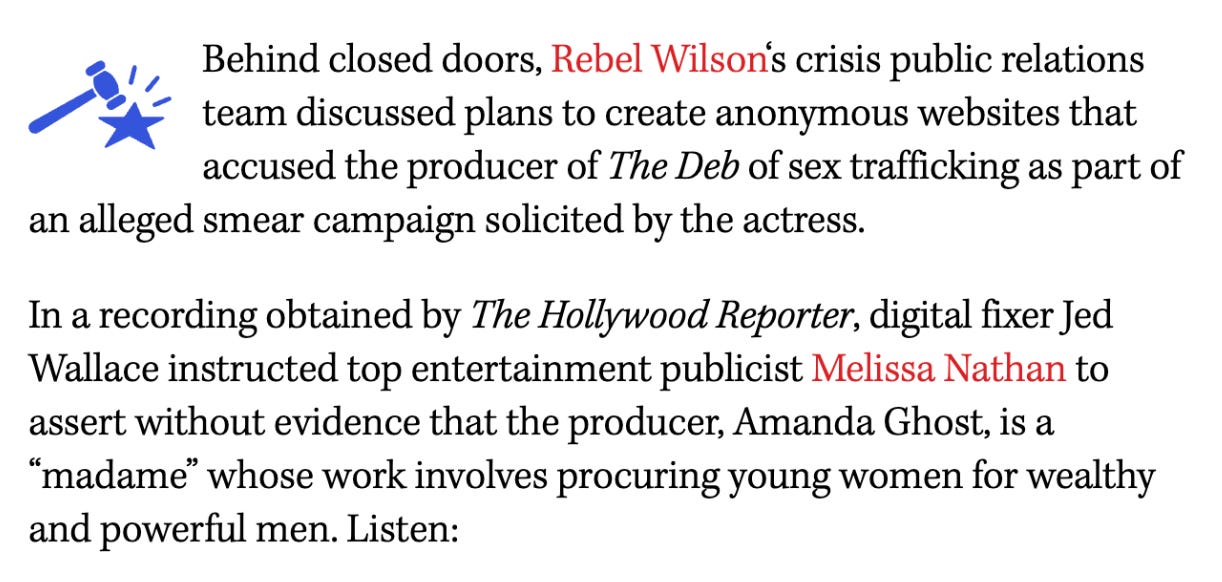
If you are a public figure with a strong media presence and plenty of reputable coverage, it is very difficult for such sites to dominate search results. But if you are someone who usually works behind the scenes and very little has been written about you before a legal dispute, people who start searching your name may find something quite different.
For companies that run these kinds of campaigns, knowing journalists is not even necessary. It is enough to understand how SEO works. But there is an interesting twist here: when high-level officials constantly claim that the media spreads fake news, it raises an obvious question - who exactly are people supposed to trust?
This is where the rhetoric of politicians sometimes plays right into their hands. When we constantly hear claims that the media spreads “fake news,” the line between real reporting and fabricated content becomes blurred, and reach begins to matter more than credibility. Even completely absurd claims can start to gain traction.
The recording bolsters the appearance that Nathan’s The Agency Group — a top PR shop in the entertainment industry whose clients have included Drake and Johnny Depp, and has frequently worked with Freedman — deployed websites featuring character-assassinating claims about Ghost. The conversation was originally recorded in order to relay instructions from Wallace to former TAG vice president Katie Case, who was not on the call. THR
What is particularly striking in this case is that the voice instructions discussing the plan to discredit the producer were recorded and later entered into the court record. The next stage will likely be the discussion moving into social media. This case also highlights a broader shift in how smear campaigns work. It is often enough to influence an algorithm and shape what appears in search results.
There is also a certain irony here. Agencies that are hired to protect reputations can sometimes end up creating a reputational crisis of their own.
For today, that’s all. I’m glad I managed to finish my very first newsletter, and I’d be very curious to hear your thoughts - if anyone actually makes it to the end. Crisis communications is a fascinating field, and I’m glad that a small community around these topics is already starting to take shape.
See you next week,
Mark
Note: This analysis is based on publicly available information and represents my personal professional opinion. It is not financial or investment advice.